
Why Is Bitcoin Lagging? Bitcoin at $86775 Today Underperforms the Broader Crypto Market by Over 4%

Key Takeaways
- Bitcoin is lagging in performance when compared to the broader market gains that other altcoins have made despite the high volatility.
- Bitcoin’s cold response to the Fed’s anticipated 25-basis-point rate cut reflects pre-priced expectations and internal disagreements within the Fed.
- Bitcoin suffered an almost 30% loss in its price after October 2025, causing huge losses to investors and increasing the selling pressure.
- According to Matthew Sigel, head of digital assets research at VanEck, there is a “crypto mini winter” going on now.
- Despite $14.8 billion in year-to-date ETF inflows, structural liquidity constraints and recent outflows—like $2.8 billion from BlackRock’s IBIT over six weeks—have caused a lack of upward momentum for Bitcoin users.
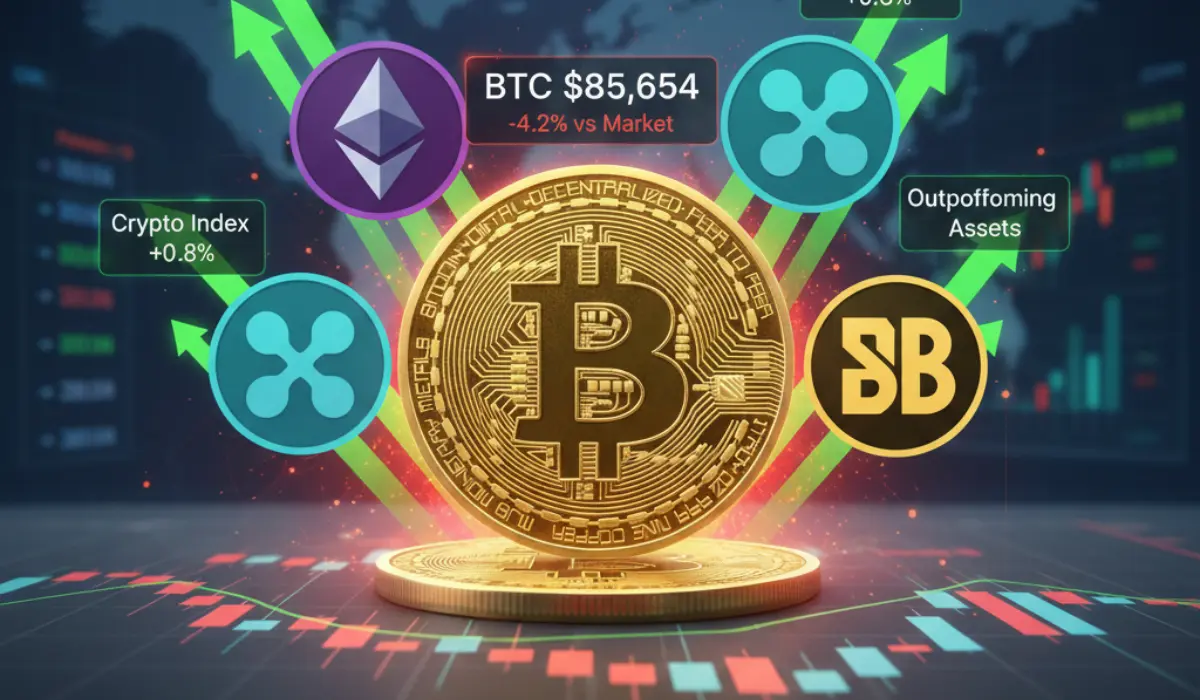
Bitcoin has seen a further downside in price performance today, with the price reaching as low as $85,654. There has been minimal gain for the coin amidst broader crypto market weakness. Bitcoin has underperformed the overall market by over 4% even when altcoins are showing relative resilience or less severe declines.
What has caused Bitcoin’s Underperformance Today?
Bitcoin is lagging in performance when compared to the broader market gains that other altcoins have made despite the high volatility. Massive liquidations exceeding $394 million in the last 24 hours, primarily long positions worth $186 million in Bitcoin, put selling pressure on the token holders as the currency has already lost support below $90,000. Bitcoin’s weak RSI also became a deterrent to buyers.
Bitcoin’s cold response to the Fed’s anticipated 25-basis-point rate cut reflects pre-priced expectations and internal disagreements within the Fed. Concerns over a potential Bank of Japan rate hike add risk-off sentiment, historically linked to 23-31% Bitcoin drops.
Despite $14.8 billion in year-to-date ETF inflows, structural liquidity constraints and recent outflows—like $2.8 billion from BlackRock’s IBIT over six weeks—have caused a lack of upward momentum for Bitcoin users. More investors are moving from volatile assets like Bitcoin to stable assets like gold, which is yet another cause for Bitcoin’s recent underperformance.
What is Next for Bitcoin?
After the inspiring price rise for Bitcoin in October 2025, investors and analysts were optimistic about cryptocurrencies ruling the market. However, contrary to what was expected, Bitcoin suffered an almost 30% loss in its price, causing huge losses to investors and increasing the selling pressure.
The future of Bitcoin is uncertain; however, there is a chance that Bitcoin may rebound in the long term if it overcomes the current bearish factors, according to market experts.
According to Matthew Sigel, head of digital assets research at VanEck, there is a “crypto mini winter” going on now. It began on October 10, when Bitcoin fell by 14%, and a Binance code error triggered the largest single liquidation event in crypto history. He says that 2026 will be a down year for Bitcoin as the asset has already reached a drawdown of 38%. The short-term outlook is mixed for the asset. Given the launch of crypto ETFs, the possibility of history repeating and Bitcoin climbing back in the long term is high.

Crypto & Blockchain Expert