

Standard Chartered, Capital A Launch Ringgit Stablecoin Pilot in Malaysia

Key Takeaways
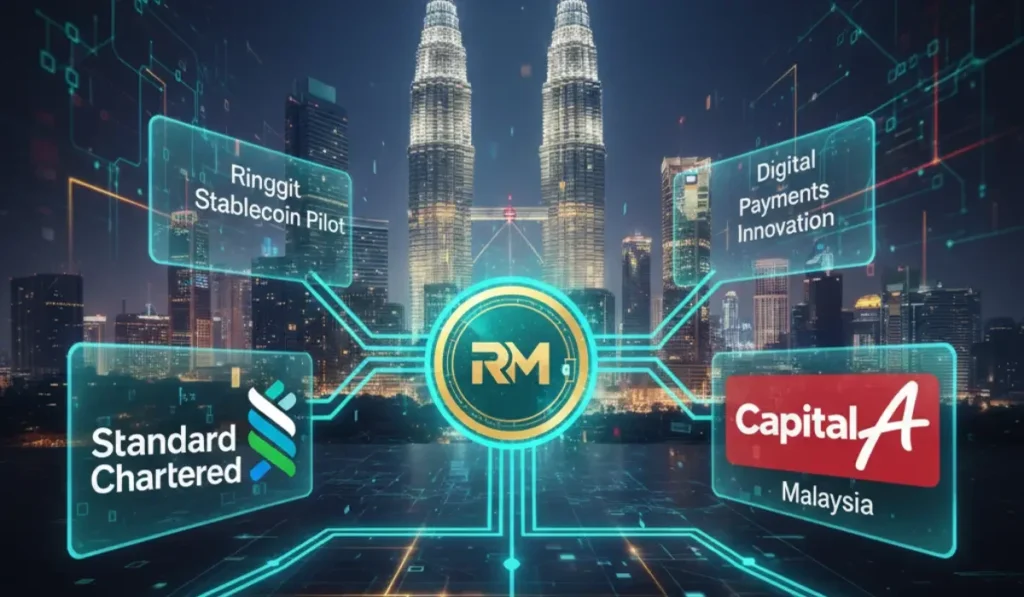
- Standard Chartered Bank Malaysia and Capital A, parent of Air Asia and BigPay, have launched a pilot program for a ringgit-backed stablecoin under the Bank Negara Malaysia’s Digital Asset Innovation Hub (DAIH) sandbox.
- Both companies aim to explore the use case of stablecoins for faster transaction settlements in the wholesale market and the efficiency of blockchain technology in aviation, supply chain, payments, and banking sectors.
- Standard Chartered will serve as the MYR-pegged stablecoin’s issuer, while entities under Capital A will be tasked with developing, testing, and piloting the token’s wholesale use cases.
- The announcement comes just days after Bullish Aim, a digital asset treasury owned by the son of the King of Malaysia, launched the RMJDT stablecoin on the Zetrix blockchain. Bullish will issue the tokens on the layer-1 blockchain and has allocated $120 million for transaction fees and validator nodes.
Standard Chartered Bank and Capital A, the parent company of Air Asia, have teamed up to test a stablecoin pegged to the Malaysian ringgit (MYR) under a national digital asset regulatory sandbox initiative launched by the country’s central bank, Bank Negara Malaysia.
The duo aims to explore digital currency for faster transaction settlements and blockchain adoption in aviation and banking. This development comes as Malaysia pushes for innovation in the digital asset space, especially stablecoins, blending traditional finance with stable assets pegged to the local currency for seamless payments.
Standard Chartered, AirAsia Parent Launch Ringgit-Pegged Stablecoin Pilot
On Friday, Standard Chartered Bank Malaysia and Capital A signed a letter of intent (LOI) to jointly explore the development and testing of a MYR-donominated stablecoin through Bank Negara Malaysia’s (BNM) Digital Asset Innovation Hub (DAIH) – an initiative announced by the central bank in June that allows fintech and digital asset companies to test new technologies under its regulatory oversight.
This marks Capital A’s first foray into regulated digital assets, with the company leveraging Standard Chartered’s institutional-grade infrastructure and financial expertise and its extensive ecosystem of companies, which includes low-cost airline Air Asia, logistics venture Teleport, and fintech platform BigPay, among others, to focus on wholesale use cases.
Standard Chartered will serve as the MYR stablecoin’s issuer, while Capital A and companies under its banner will be tasked with developing, testing, and piloting real-world whole use cases for the digital currency.
The initiative aligns with Malaysia’s pursuit of responsible innovation in the digital assets space by acknowledging the potential of ringgit-pegged stablecoins in strengthening domestic liquidity and enhancing operational efficiency, while enabling the next generation of financial services.
Capital A CEO Tony Fernandes said the deal marks a significant milestone in the company’s transformation from aviation-centric to a trusted technology-led ecosystem. He noted that a MYR stablecoin developed with Standard Chartered and tested under the Bank Negara Malaysia’s DAIH can unlock “real potential” for Capital A’s enterprise operations, which span across real-time settlements, better treasury management, and programmable flows to better serve customers.
Mak Joon Nein, CEO of Standard Chartered Malaysia, commented that the oldest operating bank in the country has always embraced innovation to support domestic growth, and digital assets are a core part of its strategy.
“Entering the stablecoin sandbox with like-minded partners like Capital A reflects that same commitment in shaping the architecture of tomorrow’s financial economy and being at the forefront of creating greater financial inclusion,” he added.
Malaysia Launches First MYR-Backed Stablecoin Under Digital Asset Policy
The announcement comes just days after Malaysia officially launched RMJDT, a ringgit-backed stablecoin, on the Zetrix blockchain. The initiative led by the Regent of Johor, Tunku Ismail Ibni Sultan Ibrahim, the eldest son of the King of Malaysia – Sultan Ibrahim Iskander of Johor – aims to strengthen the international use of ringgit in cross-border trade and to attract foreign direct investment.
RMJDT, launched under a regulated sandbox framework, is issued by Bullish Aim Sdn Bhd and will be backed by ringgit cash deposits and short-term Malaysian government bonds. The issuer will also establish a Digital Asset Treasury Company (DATCO) with an initial allocation of MYR 500 million (approximately $121 million) in ZETRIX tokens, which will be used to handle the network gas fees for RMJDT transactions and to support 10% of validator nodes that are run by the Malaysia Blockchain Infrastructure (MBI).
Last month, BNM unveiled a three-year roadmap to explore and test real-world asset tokenization across the financial sector. This roadmap anticipates that the central bank will launch proof-of-concept projects and conduct live pilots under the banner of the DAIH in the coming months.
The central bank also created an Asset Tokenization Industry Working Group to coordinate industry-wide exploration, share knowledge, and identify regulatory and legal challenges in the country.
Also Read: U.S. Teachers Union Urges Congress to Drop Crypto Market Bill, Cites Pension Risks

Crypto & Blockchain Expert