

Understanding Maximum Drawdown (MDD): Key Insights and Formula


Key Takeaways
- Maximum Drawdown (MDD) is a metric used to indicate the lowest range that an asset reaches before rebounding.
- It provides users with an idea about the historical lows of an asset so that investors understand its downside potential.
- The major limitation of MDD as a metric for risk assessment is that it does not indicate the frequency of the losses or their distribution over time.
- MDD has practical applications in crypto risk management, portfolio design, and automated risk controls.
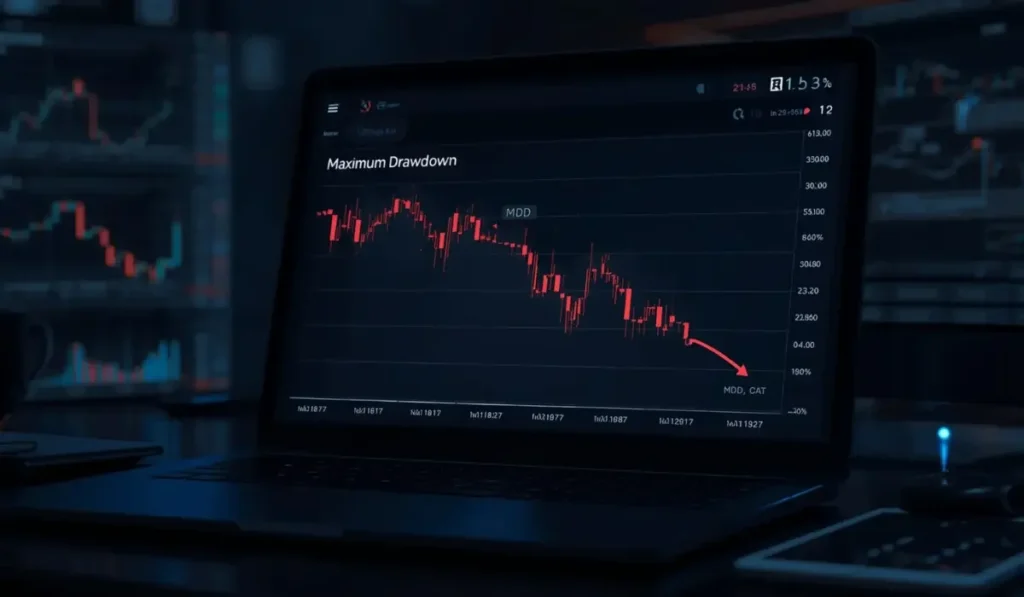
Maximum Drawdown (MDD) is a metric used to indicate the lowest range that an asset reaches before rebounding. This metric is widely used in stock and cryptocurrency markets. It is an important metric to measure the volatility of an asset. The value of an asset and its longevity will be high with the lowest MDD. A 100% MDD indicates that the concerned asset has turned out to be worthless.
How is MDD Calculated?
To calculate the MDD of an asset, you need to find out the highest value (Peak Value) and the lowest value (Trough Value).
Here is the formula used for calculating MDD.
MDD = (Trough Value – Peak Value) / Peak Value
MDD is represented as a percentage. MDD will always be a negative value, as the through value will be less than the peak value.
Major Advantages of MDD
MDD is a key metric to help in the analysis of the downside risk of an asset. It provides users with an idea about the historical lows of an asset so that investors understand its downside potential.
Investors can compare the MDD of various assets and identify those with more resilient drawdown profiles, aiding risk budgeting and asset allocation decisions. MDD is the best tool for risk assessment, helping ensure portfolios match risk tolerance during drawdowns, not just in rising markets.
When used alongside volatility, VaR, or expected shortfall, MDD provides a fuller picture of tail risk and recovery dynamics, informing better risk management practices.
Key Limitations of MDD
The major limitation of MDD as a metric for risk assessment is that it does not indicate the frequency of the losses or their distribution over time. It does not represent the duration required for an asset to recover from the drawdown, which can vary widely from one asset to the other and impact its long-term performance.
MDD represents historical data, and it is inadequate to predict the future performance of the asset. MDD is time-sensitive and depends heavily on the chosen observation window; shorter periods may understate risk, while longer ones might exaggerate it. MDD also does not reflect average risk levels or smaller, frequent fluctuations; it is not a good indicator of the overall volatility of an asset.
Practical Applications of MDD in Crypto
MDD has practical applications in crypto risk management, portfolio design, and automated risk controls. MDD is a tool to help traders reduce risk. This is done through automatic kill switches that halt trading when the losses go beyond a certain limit. Thus, MDD helps save the capital from cascading losses at times of huge market declines.
Crypto traders can use MDD as a tool for capital preservation and position tightening. That means investors can analyse the MDD and position their investments to scale back exposure as realized or unrealized drawdowns grow. This aligns risk with historical downside behavior and can reduce the likelihood of large drawdowns.
Investors can use MDD to test the robustness of a strategy, how a strategy would perform under stressed conditions (e.g., drawdown corridors), and make tailored recommendations for risk management. Investors can also use MDD to make diversification and hedging choices to minimize peak-to-trough losses.
The Bottom Line
MDD is a useful metric to assess the risks and possibilities of an asset in the market. It is the best metric for risk controls, strategy evaluation, and portfolio design. MDD helps predict the worst-case capital loss over a period of time so that investors can set expectations in a volatile market. Data quality, lookback selection, and avoidance of lookahead bias are crucial when computing MDD for live crypto strategies due to 24/7 trading dynamics.

Crypto & Blockchain Expert