
Decentralized Identity In Crypto : A US Perspective


With centralized corporations and institutions acting as the de facto gatekeepers of our personal data, the concept of decentralized digital identity has been under siege for a long time now. This model is characterized by constant re-verification and a monolithic database. However, in recent years, after several digital advancements, this model has proven itself to be flawed, with rampant data breaches leading to personal data being leaked.
It is in this situation that a new paradigm has emerged from the crypto and Web 3.0 developments. By making use of the technology that underscores blockchain and cryptography, Decentralized Identity, also known as DID, promises to give back control of personal data, which was long under centralized control, back to its owners.
Especially in the US, this movement is gaining momentum, as there is a desire for enhanced security and privacy. However, this innovation still faces formidable challenges related to regulation, interoperability, and mass adoption.
Self-Sovereign Identity: The Future of Personal Identity
The central idea of a blockchain and cryptography-supported decentralized identity is powered by the principle of self-sovereign identity or SSI. The main feature of SSI is to encourage individuals to stop relying on centralized authorities to own and manage their digital identities.
In the present situation, there are scattered identity matters across different services; for instance, there are different IDs for voting and a Driving License. Instead of this data-heavy, scattered identity, users can store a single, verifiable identity or verifiable credentials(VCs) in a secure digital wallet. This wallet will be totally under the control of the individual. All of the scattered IDs are now condensed into one tamper-proof, cryptographically protected ID. This carries several benefits.
By eliminating the central database that was the long-standing standard and distributing the data across a blockchain, DID reduces the risk of large, single-point data breaches. In addition to this, DIDs offer increased flexibility by making use of privacy-enhancing technologies like zero-knowledge proofs. With this, a user can decide what information, at any given time, is provided to a service or individual as part of verification. At the moment, verifying the name requires the entire ID’s data to be shared; this can be stopped by using DIDs.
With DID, users decide what information to share, with whom, and for how long. A portable identity means users don’t have to repeat tedious verification processes for every new service they join.
The financial sector, in particular, stands to benefit immensely. DID can streamline KYC(Know Your Customer) and Anti-Money Laundering(AML) processes, which are notoriously slow and expensive. By reusing verified credentials, banks can reduce onboarding times from days to minutes, significantly cutting costs and improving efficiency.
DID also has the potential to address digital disenfranchisement, a major issue in the US and globally. It can provide secure and accessible digital identities to unbanked and underbanked populations, granting them access to essential financial services.
Navigating The Complex Regulatory Landscape
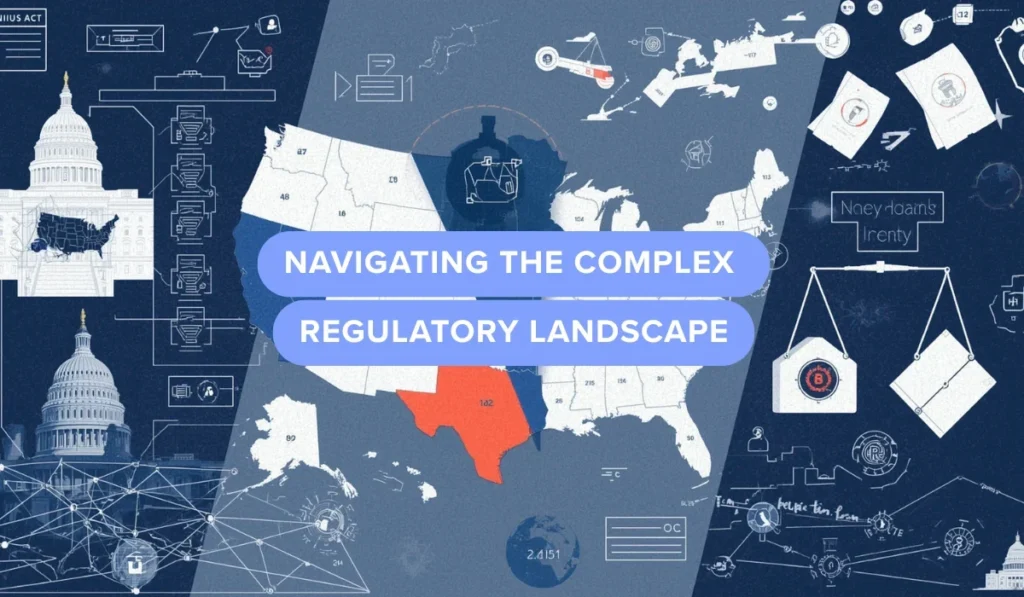
The path to mainstream DID adoption in the US is complex, largely due to a fragmented and evolving regulatory landscape. Lawmakers face a delicate balance: fostering innovation while protecting consumers and ensuring financial stability. Key regulatory developments and their impact could include what we discuss in the following sections.
Historically, the US has lacked a coherent federal strategy for cryptoregulation, with different agencies asserting authority over various aspects of the digital asset space. This has created uncertainty for businesses developing DID solutions. However, recent legislative efforts like the GENIUS Act(addressing stablecoins) and the pending CLARITY Act(defining digital assets) signal a shift towards a more structured national policy.
The regulatory picture is further complicated by state-specific laws. Some states, like Wyoming, have created tailored, crypto-friendly frameworks, while others, like New York, enforce strict licensing requirements through regulations like the BitLicense. For companies operating nationally, this requires navigating a patchwork of compliance obligations.
The US Treasury Department has shown interest in using digital identity tools, including portable credentials and blockchain monitoring, to combat illicit finance and enhance AML/CFT compliance. The proposals to integrate identity checks into DeFi or decentralized finance are highly contested by critics of DID. The main reason behind this argument is that this process could, in effect, compromise the very essence of privacy and decentralization itself.
In order to bypass this problem, there is an option by the name of sandboxes being experimented on. These systems allow for experiments to take place in a controlled environment. This comes with two benefits: it allows developers to test DID solutions in a managed environment, while the regulators, who are the main critics, can observe from outside the workings so that they can understand the technology and create guidelines accordingly.
The American Innovation
Even with regulatory clarity missing, many companies in the US are developing DID systems or are actively pursuing solutions to the problems associated with it.
Microsoft and IBM have been on the investigative path for a sustainable DID solution that can comply with regulatory requirements. These companies have also been engaged in promoting DID systems through several means. Microsoft has a DID integrated into its platform so that it can bring the technology to a wider audience.
There are crypto-focused companies, too, in this competitive realm. Civic Technology is a company that focuses on what is known as identity attestation and wallet integration. Another company by the name of ConsenSys has created the modular identity stack called Veramo. There are companies like NuID and 1Kosmos that are highly focused on building user-centered identity management systems that operate without the hurdles of complex verification and passwords.
The government is in this race too. They are exploring how they can bring DID into practice without compromising on regulatory frameworks. This is particularly taken up by the Department of Homeland Security(DHS). According to DHS, there is much potential in DID for creating secure applications. This government intervention is proof that DID is indeed a legitimate use case and that it has potential for real-world applications.
What Lies Ahead
What lies ahead for DID in terms of usage in the US is uncertain. There is immense potential, but it is hindered by regulatory constraints. There are challenges like interoperability and user experience that may need special attention.
Conclusion On Decentralized Identity In Crypto
If the nation is to move forward with DID and SSI, the US must be able to create a framework where the two technologies fit perfectly with government-mandated regulatory frameworks. In addition to this, there are problems in the realm of the underlying tech that make DID possible. Scalability and user interface are two major problems that need special care and specific workflow to make out practical implications.
If all of those problems are solved and every element can align properly, decentralized identity can truly become the system that will enhance a private, secure, and user-controlled digital world where there are no more threats of identity centralization
FAQs
Who controls the identity is the central difference that maps the two concepts apart from each other.
Blockchain provides a decentralized, tamper-proof, and secure ledger to store records, which prevents alteration or manipulation of data.
The legal landscape is highly fragmented; different states have different approaches to DID technology, and there is no uniform regulatory principle that can guide the development of a universal DID system.
The technical complexity of the technology is the main challenge apart from regulatory challenges that prevent DID from deploying in the US. The biggest challenge, apart from regulatory problems, is the complexity of the technology itself. It merits years of research and development to put a system like DID over a massive population.
VCs have the specialty of sharing only the most necessary information. This way, by using tech like zero-knowledge proofs, VCs can share parts of an identity without revealing what is unnecessary.

Crypto & Blockchain Expert