

Big Win for NVIDIA: U.S. to Get 25% from AI Chip Sales to China

Key Takeaways
- NVIDIA marks a big win as the US government green flags the export of H200 chips to the Chinese market.
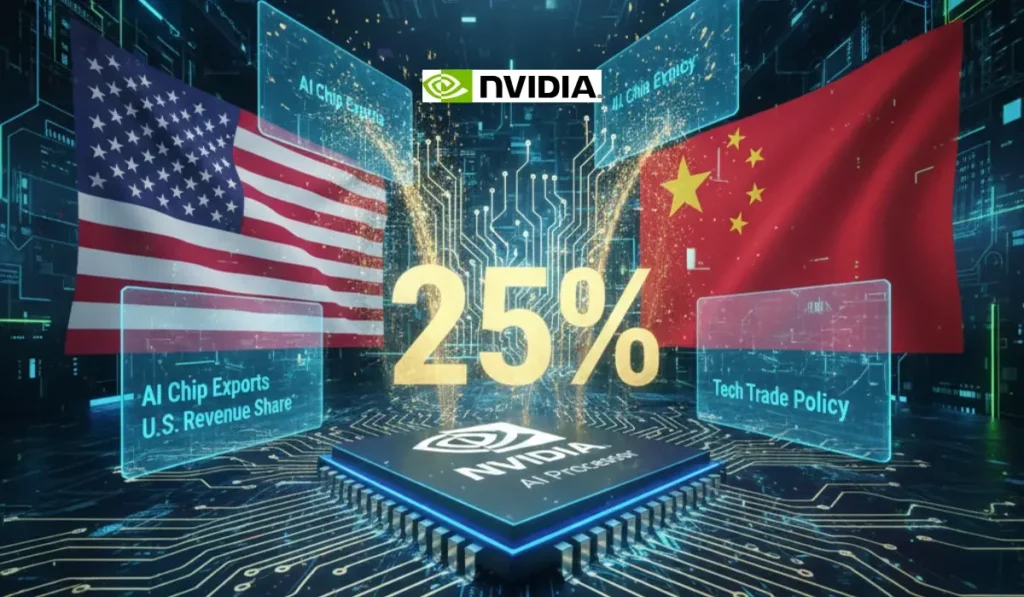
- The US government will collect 25% of the proceeds from the trade. This unorthodox method has stirred up the US bureaucracy.
- According to US President Donald Trump, the decision is a strategic victory towards making America great again.
- Certain Democrats have started war cries against the decision, but have received little support from their fellow members in the party.
A strict ban on selling NVIDIA’s powerful chips to the Chinese market was put in place during the Biden administration. After the latest discussions with Shi Jinping, the present US president Donald Trump has lifted this ban. This is a great victory for NVIDIA as they can resume selling their H200 chips to China once again.
The news has sparked great interest among investors and shareholders as NVIDIA has already been running billion-dollar profit numbers in the past quarter. This victory comes courtesy of Jensen Huang, CEO of NVIDIA, who spent months lobbying the White House to get a green flag for the cargo ships to China.
Sharing The Treasure Chest
The sale is obviously going to build a strong economic foundation for NVIDIA. The US president has stated that 25% of the proceeds gained from the sales with China will be collected by the government.
This is more than 1.5 times what was previously offered by NVIDIA. Considering the size of the Chinese market and the need for expanding to broader international markets, NVIDIA has agreed to bump up the government’s share from a previously agreed 15% to 25%.
Industry experts are saying that this won’t matter as NVIDIA chips have a great liking overseas, and the market as a whole will benefit from this move. The company agreed to the 25% without much friction, according to sources.
However, this unorthodox method of direct fund collection from private companies has raised disputes among lawmakers all around the US. Many are questioning the credibility of such a move. This dispute intensified as Trump had earlier in August stated that the US government would gain a 10% stake in Intel.
Whether this move will come to reality or become a passing fancy is yet to be decided and is something that will be unveiled in the near future. For the time being, the removal of the ban has several internal and external implications for broadening the scope of America’s industry and international politics.
Easing International Commercial Conflict
The US president announced the lifting of the ban on Monday, 8th December 2025. According to the US president, this ban will no longer be in place to prevent NVIDIA from selling chips to China and other countries.
With a multitude of nations in a race to attain supremacy in the AI development domain, the demand for NVIDIA’s products has been on the rise. The US had previously put a ban in place, citing national security issues. However, the Trump administration has green-flagged the move after careful consideration of the same issue and said that they are addressing the issue of national security through specific measures that have not been disclosed yet.
This move has eased the commercial tension that has been winding up and reaching its most tense point. The tariff war cry had already upset the market, but the recent move to approve the sale of H200 chips is being viewed as Trump’s attempt at making amends for the damage caused by the tariff announcements.
This approval has broader implications on an international level as the US is trying to build stronger commerce relations with other nations, especially India and China, which are part of the BRICS alliance. This move also coincides with Trump’s election claims that stated he would make America great again by bringing back planned production in the industrial sector.
According to the US president, the Chinese president has responded positively to the latest move made by the US. According to industry experts, this move is in light of the earlier decision made by China to manufacture its own high-end chips with the help of Huawei. It must be inferred that NVIDIA saw the potential threat in this decision and was able to persuade the US government to resume the trade of high-end chips with China.
Also Read: Strategy Expands Bitcoin Holdings By Nearly $1 Billion
The Importance of the Decision
This latest development has much importance as Trump himself stated that the Department of Commerce is finalizing the decision, and there is a plan to extend the possibility of the deal to advance towards other chipmakers in the US. A key player in this domain is Advanced Micro Devices (AMD). It is speculated that Intel, one of Silicon Valley’s biggest giants, will also board the bandwagon.
If the top dogs of the industry do decide to join the race in competing with NVIDIA, the US government is likely to make a significant gain both financially and politically. The increased competition in the high-powered chip sector is said to push the research and development processes within each of these companies to newer heights.
This is a great win for the computing industry as a whole. With better technology being developed at a stellar pace, the prices of everyday chips might come down, which could be largely beneficial for the general public all over the world.
The easing of international tension means that the flow of essential minerals from China will also be resumed. This is yet another positive aspect of the decision taken by the US government regarding the sale of H200 NVIDIA chips to the Chinese market.
The Political Friction
The move to lift the ban on chip sales to China comes with great friction from other political members of the US government. Democratic senators Elizabeth Warren of Massachusetts and Andy Kim of New Jersey have expressed their written concerns over the trade being resumed. They worry that the increased sales will cause a risk to the nation’s capacity to power surveillance, censorship, and military applications. The debate heated up as Warren publicly challenged Huang to appear in front of Congress to testify under oath.
Conclusion
While Huang calls the ban a strategic mistake, there are members of the parliament who still think that the ban is a protective barrier for America. There is no doubt that with this move, the US job market and the chip industry of America will get renewed strength. This could explicitly help Trump’s political case and strengthen the Republican Party’s foothold over the American population.
Many consider the voices of resistance raised against the lifting of the ban come from a political standpoint. This has created a divide within the Democratic Party, as it was through several bipartisan agreements that this was made possible. The Democrats are getting increasingly frustrated as their leadership is unable to maintain coherence regarding matters of significant importance. How this whole turn of events will reshape the international business sectors is yet to be determined; however, the general sentiment all around the world has been positive regarding the US becoming more open to trade agreements with other nations of the world.
Also Read: Strategy Expands Bitcoin Holdings By Nearly $1 Billion

Crypto & Blockchain Expert